
Candy Casino Registration & KYC: Account Rules and Verification
 Available in US
Candy Casino’s current Terms and Conditions list Australia and its territories among restricted locations. That restriction comes before any account discussion: this page explains Candy’s published registration and verification rules, but it is not a sign-up guide for Australians and does not provide a way around the restriction.
Where an account is permitted, Candy’s terms require the player to be at least 18, provide true and complete registration information and follow a one-account rule. The operator can conduct KYC at any time. Current terms list a passport or ID, a selfie with the document and payment-card evidence where applicable as possible verification items. They also state that no withdrawals are processed until verification is complete and that document verification takes up to 24 hours after the last document is submitted.
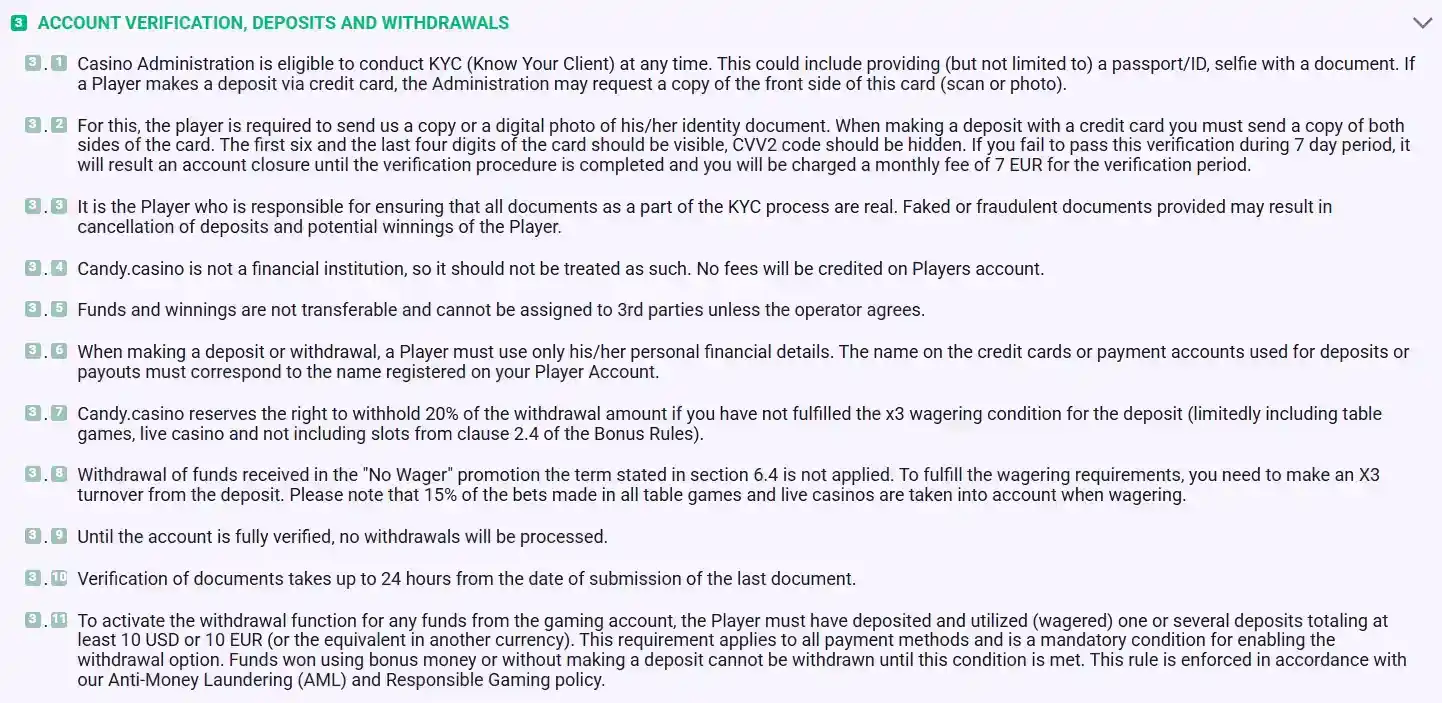
Table of Contents
- Account rules at a glance
- The Australia restriction is separate from the registration form
- Registration information has to be accurate
- One-account rule and duplicate-account consequences
- What KYC documents can Candy request?
- How long does document verification take?
- Verification is a withdrawal prerequisite
- Deposit limits and account-control routes
- Closing an account and contacting support
- KYC checklist
- Sources
Account rules at a glance
The useful way to read Candy’s account terms is as a chain of dependencies. Registration information creates the account record, payment ownership has to match that identity, KYC can test the record, and a withdrawal cannot move forward until verification is complete. Treating each item separately can hide why an apparently small mismatch later becomes a cashout problem.
| Account issue | Current Candy rule | Practical meaning |
|---|---|---|
| Australia | Australia and its territories are listed among restricted locations. | Do not treat registration mechanics as evidence that Australian access is allowed. |
| Minimum age | Casino games are prohibited to users under 18. | Age is a basic account eligibility condition. |
| Number of accounts | One player is allowed one account, with additional household, IP and PC limits stated in the terms. | Duplicate-account activity can trigger blocking, cancellation or forfeiture consequences under the operator’s rules. |
| Registration data | Requested information, including a valid email address, must be true, complete and correct. | Identity and account records need to remain consistent. |
| Payment ownership | Deposits and withdrawals must use the player’s personal financial details, with names corresponding to the player account. | Third-party or mismatched payment details create a verification risk. |
| KYC | Candy can conduct KYC at any time. | Verification should be expected as an account-control process, not treated as an exceptional event. |
| Withdrawal gate | No withdrawals are processed until the account is fully verified. | Verification readiness directly affects access to cashout. |
The Australia restriction is separate from the registration form
A registration page, login screen or visible cashier does not override a country restriction in the operator’s own terms. Candy’s current T&C explicitly name Australia and its territories in the restricted-country clause. That makes the eligibility question distinct from the technical question of how an account form works.
These are two different things: “the site has a sign-up form” and “a resident of this country is allowed to use it”. The first is an interface observation. The second requires country-specific evidence. For Candy and Australia, the current primary-source evidence points to a restriction.
The wider Australian regulatory and licensing picture is handled on the Candy Casino licence and legal status page. This account page stays focused on what Candy’s own rules say about identity, account ownership and verification.
Registration information has to be accurate
Candy’s terms require the player to enter the relevant information requested in the registration form, including a valid email address, and place responsibility on the player for making sure the information is true, complete and correct. That wording is more important than the number of fields on a particular version of the sign-up screen.
From a verification perspective, accuracy is cumulative. A name entered one way at registration, a different name on a payment account and a third variation on an identity document can create a chain of inconsistencies. The operator’s terms also say that the name on credit cards or payment accounts used for deposits or payouts must correspond to the name registered on the player account.
Enter accurate details during registration rather than waiting until withdrawal to correct them. The account record becomes the reference point for later KYC and payment checks. Consistency at this stage reduces avoidable verification friction later. This is one reason the page avoids a click-by-click sign-up tutorial: the quality of the information entered matters more than the order of buttons.
One-account rule and duplicate-account consequences
Candy’s current terms state that one player is allowed only one account. They also describe one-account limits connected to a household, IP and PC. The terms reserve consequences for attempted duplicate accounts, including blocking or closing accounts, cancelling bets and dealing with deposits, winnings or bonuses associated with a duplicate account.
These are operator terms rather than Australian statutory rules, so they should be described precisely as Candy’s account policy. They are relevant to KYC because duplicate-account checks can involve identity, device, household and payment signals at the same time.
If an account duplication issue already exists, creating another account is not a sensible remedy. Candy’s own terms direct the player to contact the manager at its support address if another account is required and say the previous account will be closed when a new account is opened. That is an account-management route, not permission to evade country or identity controls.
What KYC documents can Candy request?
Candy’s current terms say the casino administration can conduct KYC at any time. The examples named in the live text include a passport or ID and a selfie with the document. Where a credit card is used, the terms say the administration can request card evidence.
The same section gives more specific handling language for card copies. It says the first six and last four digits should be visible and the CVV2 code should be hidden. That is a useful privacy distinction because a verification request is not a reason to expose the card security code.
The listed KYC documents are examples from Candy Casino terms. If the casino requests other documents, follow the current request shown in your account.
For the same reason, the examples are not presented as a guaranteed fixed checklist. The terms use open-ended KYC language, so the safest statement is that these are documented examples of what Candy can request.
How long does document verification take?
The current Candy terms state that verification of documents takes up to 24 hours from submission of the last document. This timing was checked against the live T&C because verification timing can change.
The scope of that number matters. It describes document verification after the last document has been submitted. It is not a promise that registration, account review, withdrawal approval and final payment all finish within 24 hours. A cashout can contain other stages, including account checks and payment processing.
Document verification time and withdrawal processing time are separate and should not be treated as one payout time.
Verification is a withdrawal prerequisite
Candy’s terms are explicit that no withdrawals are processed until the account is fully verified. This makes KYC operationally important even for someone who did not encounter a document request at the first account interaction.
There are two practical consequences. First, identity and payment ownership should be kept consistent before a withdrawal request. Second, a pending verification request should be treated as part of the withdrawal dependency chain rather than as a separate customer-service issue.
This does not establish an exact total payout time, cashout fee or Australian withdrawal limit. Check current withdrawal limits, fees and timing in the casino cashier, as these details can change. The account page stops at the verified dependency: incomplete verification can stop processing from beginning.
Deposit limits and account-control routes
Candy’s terms say players can set daily, weekly or monthly deposit limits by contacting support or finance. The terms list [email protected] and [email protected] for that process. This is an account-control feature, not an Australian statutory limit and not evidence that Candy is part of an Australian responsible-gambling scheme.
The difference is important. A voluntary operator-level deposit limit is a control inside that operator’s account system. It should not be confused with BetStop, local licensing protections or mandatory limits that may apply to Australian licensed wagering providers.
If the purpose is to understand bonus eligibility, the separate Candy Casino bonuses page deals with promotions without turning an account-control feature into a promotional reason to register.
Closing an account and contacting support
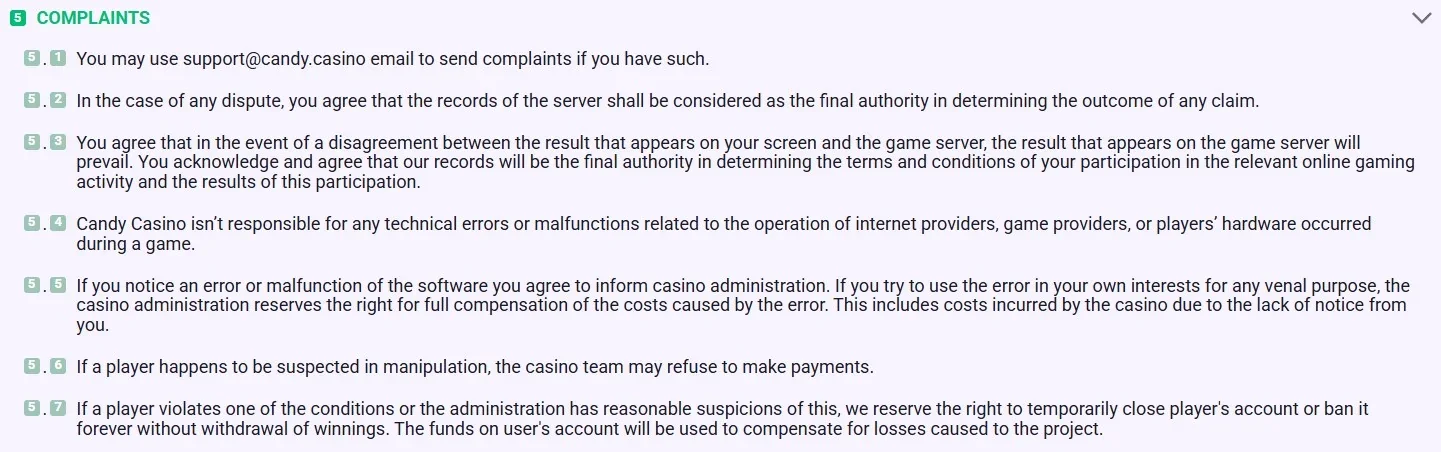
Candy’s current terms say a player who wants to close an account should contact customer support. They also list [email protected] for complaints. This matters because an identity dispute, duplicate-account issue or verification delay can turn into an account-management problem rather than simply a payment problem.
For a complaint, preserve the account identifier, dates, copies of requested documents or request descriptions, submission times and the operator’s responses. Do not send unnecessary full card data in ordinary email correspondence. If card evidence is requested through an authorised verification process, follow the operator’s current masking instructions and never expose the CVV2 code.
The related Candy complaints and support page covers escalation records and dispute signals in more detail.
Account records are most useful when they are kept before a problem occurs. Saving the version of the terms that applied, the time a KYC request arrived and the time the final requested document was submitted makes it easier to distinguish a verification delay from a separate withdrawal or support dispute.
KYC checklist
- Check eligibility first. For Australia, Candy’s current official T&C list Australia and its territories as restricted.
- Use accurate account data. Registration information should be true, complete and correct.
- Keep payment ownership aligned. The name on payment details should correspond to the player account.
- Avoid duplicate accounts. Candy operates a one-account policy and describes consequences for duplicate accounts.
- Respond only to the actual KYC request. The live terms name ID or passport, a selfie with the document and card evidence where applicable. Do not invent a larger standard checklist.
- Protect sensitive card information. Candy’s current terms say the CVV2 should be hidden when card copies are supplied.
- Record when the last document was submitted. The current terms measure their up-to-24-hour verification statement from that point.
- Do not equate KYC time with payout time. Verification is a withdrawal gate, not the entire payment journey.
For the wider access, payment and regulatory context, return to the Candy Casino Australia review.
Sources
- Candy Casino Terms and Conditions – current Australia restriction, account rules, KYC examples, payment-ownership requirement, verification timing, deposit limits, account closure and support contacts.
Written by the editors at Candy Casino.